
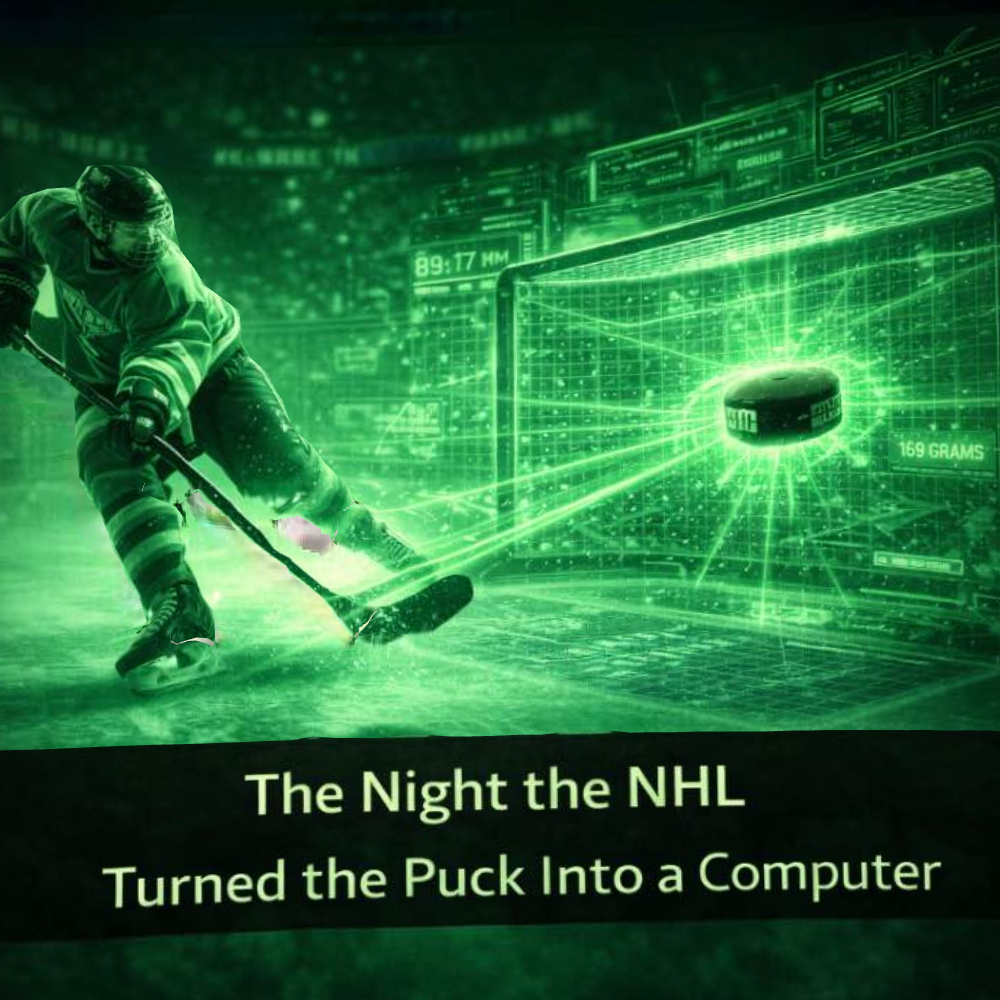
Hockey Was Too Fast for Television
In the mid-1990s, the National Hockey League had a visibility problem.
Hockey was fast. Too fast for television. Fans watching from home constantly lost the puck, especially casual viewers who had not learned how to track it instinctively. Broadcasters understood the risk. If people could not follow the action, they would never fully connect with the game.
So the league tried something that sounded more like engineering than sports.
They turned the puck into a computer.
Not as a metaphor. Literally.
 When the Puck Lit Up
 When the Puck Lit Up
During NHL broadcasts on Fox in 1996, viewers suddenly saw something strange. The puck glowed blue as it moved across the ice. On slap shots, it flashed red and left a visible trail.
It looked futuristic. Almost cartoonish.
The system was called FoxTrax.
What most fans never realized was that the effect was not added later in a studio. The intelligence lived inside the puck itself.
The Technology Inside the Puck
Each FoxTrax puck contained infrared emitters and a tiny embedded circuit. Around the arena, sensors and cameras tracked those signals in real time. Custom-built computers calculated the puck’s position up to thirty times per second and overlaid its movement directly onto the live broadcast.
This was the mid-1990s.
Before smartphones. Before modern motion tracking. Before real-time analytics were normal in professional sports.
Tracking Was Not the Hard Part
The hardest problem was not knowing where the puck was when it was visible.
It was knowing where it was when it disappeared.
The system had to account for player skates, bodies, boards, camera movement, ice reflections, and speed. When the puck vanished behind traffic, the software predicted where it was and where it would reappear.
That was not just tracking.
It was inference, happening live.
Built to Survive Hockey
The colour changes were not cosmetic. Red flashes on slap shots were calculated instantly based on velocity, often exceeding ninety miles per hour.
At the same time, the puck had to behave exactly like a normal puck.
It had to survive slap shots, board battles, freezing temperatures, and constant impact without changing its weight or balance. Engineers tested hundreds of prototypes to make sure players never noticed a difference.
Players barely did.
Broadcasters noticed everything.
Why Fans Rejected It
For the first time, television could present hockey the way it felt on the ice: fast, violent, fluid, unforgiving.
And many fans hated it.
Purists said it distracted from the game. Traditionalists said it felt artificial. Coaches ignored it. Players were indifferent. The technology worked, but it collided with hockey culture at the wrong moment.
By 1998, FoxTrax was quietly retired.
Most people remember it as a gimmick.
The Foundation It Left Behind

FoxTrax was not a failure. It was early.
The problems it solved are the same ones behind modern player tracking, puck tracking, and advanced sports analytics. Today, NHL systems capture every stride, every puck movement, every shot angle, and every zone entry using computer vision and sensor fusion.
Coaches study heat maps and motion models. Broadcasters use subtle overlays fans barely notice.
All of it traces back to the glowing puck people laughed at in the 1990s.
What the Future Looks Like at First
The NHL did not abandon the idea. It waited for computing power, sensors, and audiences to catch up.
The night the NHL turned the puck into a computer did not change hockey overnight. But it quietly rewired how the game would be measured, analysed, and understood.
Most fans never realized they were watching the future slide across the ice.
And that pattern matters beyond hockey. Transformational technology rarely announces itself as inevitable. It usually shows up looking awkward, unnecessary, or distracting before becoming invisible. For organizations exploring AI, analytics, or emerging technology today, the lesson is simple: the most important shifts often start as uncomfortable experiments. Recognizing the future early is not about certainty. It is about paying attention before the glow fades into the background.
