
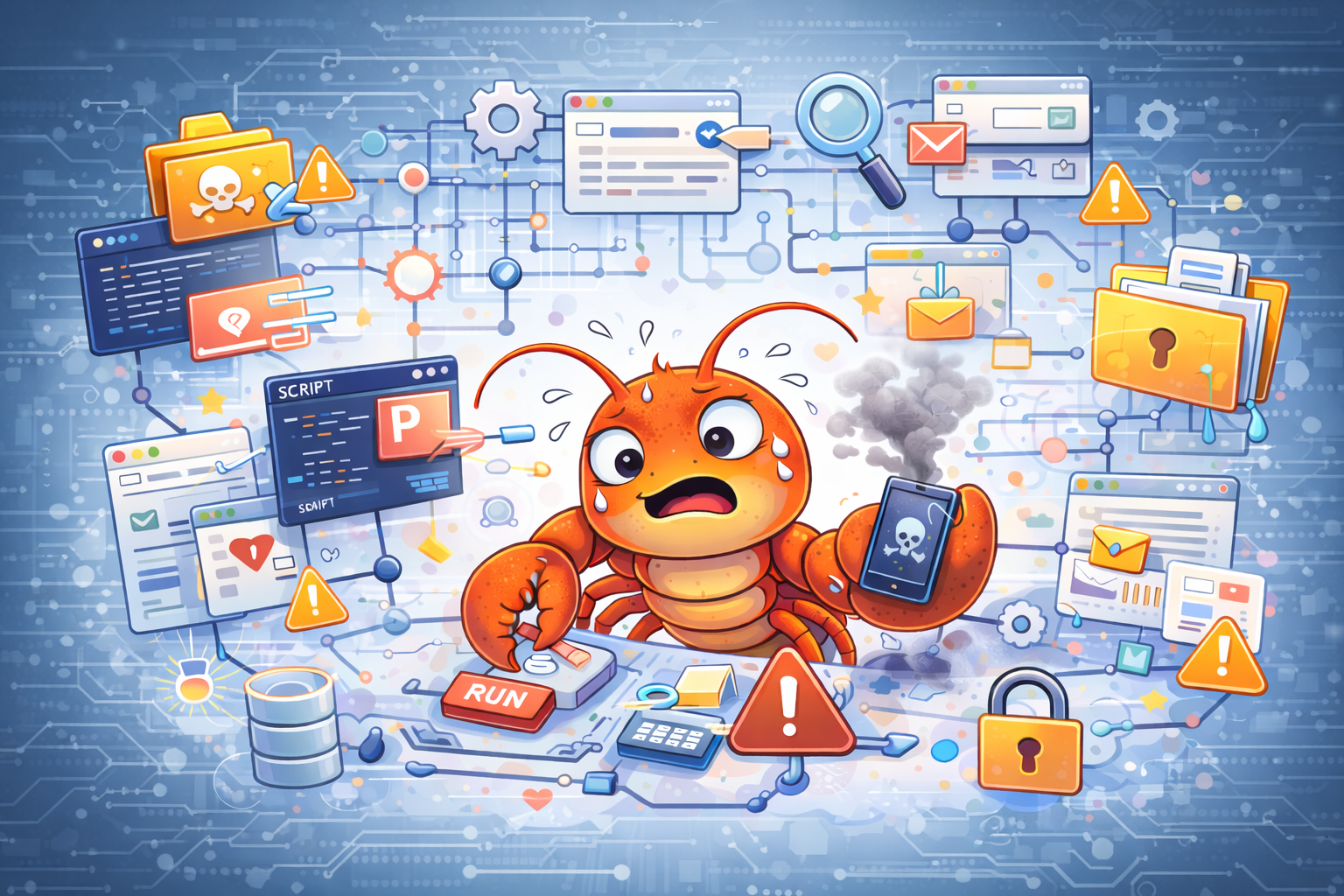
AI assistants are moving fast from “helpful chatbots” to software that can take real action on your system. Tools like OpenClaw, formerly Moltbot and Clawdbot, run locally and can modify files, install dependencies, and run commands without you watching every step.
That power is also the problem. The same permissions that make these agents useful introduce a new category of risk. This is the core of what many are calling the Permissions Trap.
From Talking to Acting
We’re no longer dealing with AI that only answers prompts. We’re dealing with systems that perform tasks. OpenClaw is a good example. It has shell access, can move through your file system, and can act on its own once a task is set in motion.
This unlocks real automation. It also removes the safety barriers we’ve relied on for years. Security researchers highlight three main concerns:
- Access to sensitive data
- Ingesting untrusted content from email, websites, and feeds
- Authority to take action based on what it processes
If that input is malicious, the agent can run commands, move files, or send data out without the user ever being aware. No phishing click required.
The Hidden Issue: Time‑Shifted Risk
Persistent agents add another wrinkle. OpenClaw’s Heartbeat feature lets it wake up on a schedule, check stored information, and complete background tasks.
This creates delayed execution. An agent might consume something today and act on it hours later. When input and action are separated in time, detection becomes harder.
Plugins and Supply Chain Exposure
Most AI agents expand their capabilities through plugins or skills. OpenClaw uses external repositories like ClawHub.
This creates supply chain risk similar to open-source software, but with higher impact. A malicious plugin doesn’t live in a sandbox. It inherits the agent’s permissions, which may include full system access.
Researchers have already found unsafe and malicious skills in public repositories. Even well-intentioned ones can introduce risk through excessive permissions or poor validation.
The Core Problem Remains
Developers are trying to reduce exposure with sandboxing, scoped permissions, and better input handling. These are helpful, but they don’t solve the underlying challenge.
For an AI agent to act as a true assistant, you have to trust it with access. As long as untrusted input can reach privileged actions, that trust is difficult to scale safely.
The Permissions Trap is bigger than any single product. It’s a structural challenge as AI agents get closer to our operating systems and daily workflows. Our security models will need to evolve just as quickly as the tools themselves.
